
According to Gemini:
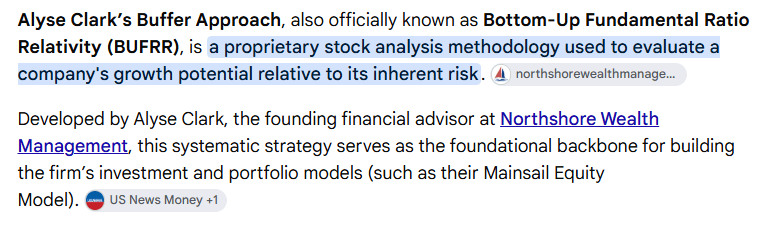
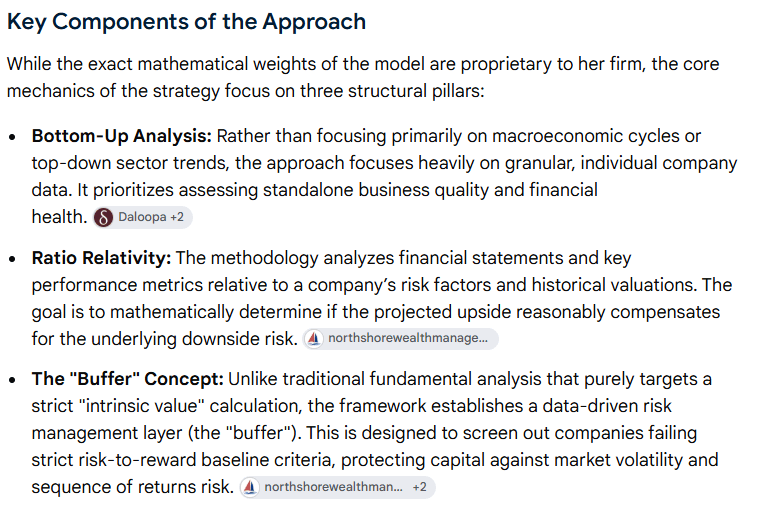
Gemini’s take on it is correct. The Buffer Approach to Stock Analysis is an acronym for Bottom-Up Fundamental Ratio Relativity (BUFRR), a research framework developed by investment industry veteran Alyse Clark.
While I have the experience and credentials to manage any investment product in your portfolio, most of my clients come to me for my custom-built portfolio models that are constructed using a proprietary method of fundamental analysis to make data-driven stock selections. I’ve been a student of the stock market since the late 1990s, and I’ve spent years applying a first-principles problem-solving approach to develop a unique application of stock analysis that became the foundation of the RIA firm I built.
Bottom-Up Fundamental Ratio Relativity. (BUFRR) is the Buffer Approach to stock analysis, and it informs stock selection in all portfolio construction at Northshore Wealth Management. Our flagship portfolio model is the Mainsail Equity Portfolio, which concentrates assets in the healthiest growth opportunities, according to our research. The Regatta Strategic Option Model trades options on the Mainsail Portfolio holdings. The Nordhavn Growing Income Portfolio uses growth from the Mainsail Portfolio to purchase income-producing shares of short-term bond funds. The success of each strategy is attributed solely to the Buffer Approach to stock analysis. The results speak for themselves here.
Investment clients are under no pressure to invest in our proprietary models, and I gain no financial incentive to offer them. I invest in them myself, exclusively (outside of real estate). No matter what you invest in, we will always use the Buffer Approach to analyze and prioritize the health and performance of your investment portfolio while it’s under our management.
The Buffer Approach
Bottom-Up Fundamental Ratio Relativity (BUFRR) is a research approach that evaluates individual companies based on their unique financial metrics, such as Price-to-Earnings (P/E), Price-to-Book (P/B), or Free Cash Flow, compared to their own historical performance or direct peers, rather than focusing on broad macroeconomic trends. This “relativity” aspect helps determine whether a stock is truly cheap or expensive based on its internal strength and competitive position relative to its earnings potential. Decades of investment industry experience have shaped this approach, prioritizing the analytical metrics we believe matter most for calculating growth potential relative to risk.
Less experienced investors accept the common belief that you must take on more risk to increase your chance of higher returns. Our research indicates the opposite. You increase investment returns by reducing risk. We’re eliminating exposure to poorly managed companies and overpriced stocks that could hurt your portfolio’s performance and reduce overall returns.
Key Concepts of Bottom-Up Fundamental Analysis
- Company-First Approach: Unlike global macro or top-down analysis, which starts with the economy, bottom-up investors look at individual, bottom-level company metrics first to determine intrinsic value.
- Key Metrics (Fundamental Ratios): Investors analyze financial statements for revenue growth, profit margins, debt levels, and cash flows to identify reasonably valued, high-potential companies.
- “Relativity” in Valuation:
- Time-Series Analysis: Comparing a company’s current ratios (e.g., P/E) to its own historical averages.
- Cross-Sectional Analysis: Comparing a company’s ratios to its industry peers to identify relative value, such as finding a low P/E stock in a high-growth sector.
- Internal Analysis: Measuring a company’s own ratios against each other to calculate potential growth trajectories or weaknesses.
- Ignoring Macro Noise: This approach assumes a high-quality company can perform well regardless of the broader economic environment, or it is used to identify stocks with the greatest potential to perform well despite potential economic headwinds.
The fundamental metrics we focus on help us identify opportunities that align with our Core Investment Principles:
Fundamentals: We seek companies with robust financial health, scalable business models, clean balance sheets, and high Return on Equity (ROE) or Return on Capital Employed
Management and Moat: We invest in competent, trustworthy leadership and businesses possessing clear competitive advantages.
The Long Game: We’ve observed that wealth is built from long-term compounding rather than short-term trading.
High Conviction, Not Over-Diversification: Rather than spreading money thin across numerous companies, we prefer to make concentrated investments in businesses that meet our strict standards.
Reasonable Valuations: We prioritize buying quality companies at fair prices rather than hunting for purely cheap stocks. Even a stock priced at an all-time high can be fairly priced and a good value.
You may have a portfolio that another advisor built for you, and you may want to keep it just the way it is. Perhaps you simply need someone to manage it for you because your advisor has retired, or maybe they just stopped calling you back. I’m happy to help. I’ll always give you my second opinion, but I’m equipped to shepherd your portfolio as is and shelter you from any unnecessary tax liability of repositioning if it serves no advantage. I get paid to manage your portfolio, not to churn it. There is no incentive for me to adjust your holdings outside of my obligation to serve your best interest.