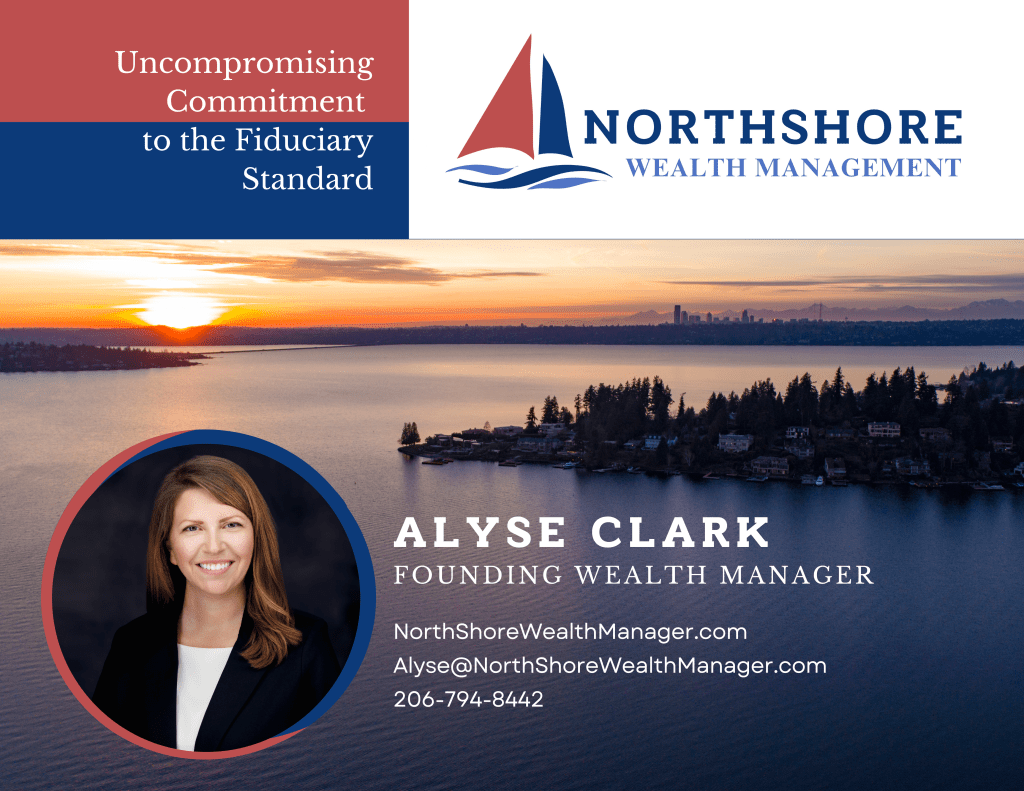
Your portfolio is our priority.
I am an independent wealth manager serving investment clients across the United States. Let me preface this page by saying I am a writer who knows most people aren’t readers. My clients come to know that if anything I write is critically important, it will be labeled as such. Everything else is entirely optional reading.
At Northshore Wealth Management, I limit the scope of my business to serving a select clientele that values boutique wealth management services. Maintaining a small practice ensures its long-term sustainability and a commitment to a high standard of performance. Two decades of industry experience have taught me that the quality of client relationships drives success more than the quantity of accounts.
Studies show that boutique asset managers have historically and consistently outperformed larger asset management firms with higher returns for their clients. Here’s a look at some of the reasons why:
- Specialization and focused expertise: Boutique firms are often built upon expertise in specific niches, asset classes, or client segments, attracting clients seeking specialized knowledge and a tailored approach.
- Personalized service and strong client relationships: Smaller firms can offer a more high-touch, individualized experience, fostering strong relationships built on trust and a deep understanding of client goals and risk tolerance.
- Agility and flexibility: Their smaller size allows for greater responsiveness to market changes and client needs, potentially adapting more quickly to new regulations or investment opportunities.
My personal theory behind these results is that you really have to care about the work that you do in order to want this job. In other words, someone who isn’t highly focused, inspired, and driven by a mission won’t last in the independent segment of the investment industry. You must have a deep, resounding purpose to be here.
I have worked for public figures, and I’m fiercely protective of my clients’ privacy and confidentiality. I equally value my own privacy and the solitude of my home office. I limit the time I spend traveling to in-person meetings to focus on my best work, serving as an asset to my clients. Do you want me traveling to sit in meetings all day, or do you want me managing your assets? Also, leasing an office space in Seattle serves no value to my clients across the state and across the country.
At Northshore Wealth Management, I specialize in wealth preservation. I know how hard you worked to build your wealth because I know how hard I worked to build mine. I want to protect what you’ve built, just as I protect my own. Wealth preservation strategies are a foundational focus in my practice. That being said, I wouldn’t have been able to build my own wealth without also specializing in asset growth. I’ve been a student of the stock market since the late 1990s, and have spent years applying the problem-solving approach of reasoning from first principles toward developing a unique application of stock analysis called
The Buffer Approach
Bottom-Up Fundamental Ratio Relativity (BUFRR) is an investment approach that evaluates individual companies based on their unique financial metrics, such as Price-to-Earnings (P/E), Price-to-Book (P/B), or Free Cash Flow, compared to their own historical performance or direct peers, rather than focusing on broad macroeconomic trends. This “relativity” aspect helps determine if a stock is truly cheap or expensive based on its internal strength and competitive position, rather than just its nominal price.
Key Concepts of Bottom-Up Fundamental Analysis
- Company-First Approach: Unlike top-down analysis, which starts with the economy, bottom-up investors look at individual, bottom-level company metrics first to determine intrinsic value.
- Key Metrics (Fundamental Ratios): Investors analyze financial statements for revenue growth, profit margins, debt levels, and cash flows to identify undervalued, high-potential companies.
- “Relativity” in Valuation:
- Time-Series Analysis: Comparing a company’s current ratios (e.g., P/E) to its own historical averages.
- Cross-Sectional Analysis: Comparing a company’s ratios to its industry peers to identify relative value, such as finding a low P/E stock in a high-growth sector.
- Internal Analysis: Measuring a company’s own ratios against each other to calculate potential growth trajectories or weaknesses.
- Ignoring Macro Noise: This approach assumes a high-quality company can perform well regardless of the broader economic environment, or it is used to identify stocks with the greatest potential to perform well despite potential economic headwinds.
The Role of Relative Valuation
The “Theory of (Value) Relativity” in a bottom-up context is used to avoid value traps.
- Avoiding the “Cheap” Trap: A stock that has dropped 50% might look cheap in absolute terms, but if its fundamental ratios (e.g., P/E) remain high or its fundamentals are deteriorating, it is not actually cheap relative to its earnings power.
- Relative Strength vs. Absolute Price: Focusing on relative strength (how a stock performs) is often more important than the absolute price movement.
Advantages and Applications
Identifying Undervalued Opportunities: It helps identify companies that are temporarily overlooked by the market but have strong fundamentals.
Identifying Risk: Measuring price ratios relative to overall company performance helps identify and avoid overvalued positions.
Broad Sector Rotation: You can find opportunities in places you may not have otherwise been looking.
Long-Term Focus: This approach is well-suited for long-term investors aiming for sustainable growth.
The Buffer Approach to fundamental stock analysis is used to guide portfolio construction at Northshore Wealth Management, and I let the results speak for themselves. I’ve studied market trends and capitalized on them for over two decades, and by drawing on that experience, I’ve built Northshore Wealth Management’s flagship portfolio model, The Mainsail Equity Model. When market winds change, we adjust our sails to stay on course. Mainsail can be used on its own or in combination with other strategies to supplement a portfolio’s overall performance. If a concentrated growth stock allocation isn’t appropriate for your needs, then we won’t use it at all.
Our data-driven allocation strategies ensure that data and facts drive our decisions, not assumptions, fear, hope, or euphoria. We don’t select stocks based on what we think; we select stocks based on what we know. Each stock must meet specific fundamental criteria to earn a position in our investment models, and the size of a position is determined by its score on each of these criteria. Our carefully crafted rules protect investors from speculative betting.
You may have a portfolio that another advisor built for you, and you may want to keep it just the way it is. Perhaps you simply need someone to manage it for you because your advisor has retired, or maybe they just stopped calling you back. I’m happy to help. I’ll always give you my second opinion, but I’m equipped to shepherd your portfolio as is and shelter you from any unnecessary tax liability of repositioning if it serves no advantage. I get paid to manage your portfolio, not to churn it. There is no incentive for me to adjust your holdings outside of my obligation to serve your best interests.
Asset management at Northshore Wealth Management begins with portfolios above $200,000. Regardless of your portfolio size, my book, Makings of a Millionaire – Observations of a Financial Advisor, will offer my advice and insight to any reader. The premise is that no investment’s performance can outpace an unsustainable lifestyle or spending habit, so you’ll have to earn more and spend less to close the gap between what you have and what you want. This book shares the habits, patterns, and mindsets I’ve observed in investors who have become millionaires over the years that I’ve worked for them. I hope to have it published and available soon.
Where is the North Shore? It could be the community I’m based in on the northern shore of Lake Washington. It could be the north shore of Lake Chelan, where I enjoy spending time. It may also be the north shore of Lake Wenatchee, my childhood playground. I live at a northern latitude where the north shore is an ideal position to benefit from the warmth of sun exposure – a metaphor for finding the ideal position for market exposure relative to your position in life. Wherever I am, I always carry my laptop with my own secure hotspot, my work phone, and a backup power supply. I’m logged in, taking your calls, meeting with you over video chat, and shepherding your assets as your dedicated wealth manager. Living well keeps my mind and body sharp enough to stay at the top of my game, enabling me to do my best work for you.
I’m a firm believer in living well, and I encourage all of my clients to live well while they can. Make memories with your loved ones as much as you make money for them. My mom only stopped working when she became sick with cancer, and then she passed away. She never enjoyed a retirement, and my only memories are of her constant exhaustion from work. This taught me to live well while I can. I don’t want that life for me or for you. That’s why my mantra is “Live Long and Live Well”. I built this private practice to keep it small, allowing me to balance work and life at a level I can sustain for decades to come. I’m only in my 40s, and I hope to serve my clients as long as my brain remains sharp. I’m looking forward to my days helping you instead of feeling burned out and looking for an escape.
When I’m not studying stock fundamentals, I’m studying sports nutrition to support my young elite athlete’s ambitions. I’m growing fresh produce for him in our garden, and I’m eating dust trying to keep up with him on mountain bike trails.

If you find my candor more refreshing than off-putting, then I might be a good fit as your dedicated wealth manager. Research me at The U.S. Securities and Exchange Commission. I’m currently accepting new clients.
Live long and live well,
Alyse
Your portfolio is our priority.
Alyse Clark is a registered investment adviser in the State of Washington. The adviser may not transact business in states where she is not appropriately registered, excluded, or exempted from registration. Individualized responses to persons that involve either the effecting of transactions in securities or the rendering of personalized investment advice for compensation will not be made without registration or exemption. The opinions expressed herein are those of the firm and are subject to change without notice. Any projections or forward-looking statements expressed herein are solely those of the author and may differ from the views or opinions expressed by other firms and are only for general informational purposes as of the date indicated. Past performance of information presented should not be relied upon without knowledge
of certain circumstances of market events, the nature and timing of the investments, and relevant constraints of the
investment.
The information presented here is for educational purposes only and intended for a broad audience. The information does not intend to make an offer or solicitation for the sale or purchase of any specific securities, investments, or investment strategies. Investments involve risk and are not guaranteed. The advisor has a reasonable belief that this marketing does not include any false or materially misleading statements or omissions of facts regarding services, investment, or client experience. Northshore Wealth Management has a reasonable belief that the content as a whole will not cause an untrue or misleading implication regarding the adviser’s services, investments, or client experiences.
Northshore Wealth Management may discuss and display charts, graphs, formulas and/or stock picks which are not intended to be used by themselves to determine which securities to buy or sell or when to buy or sell them. Such charts and graphs offer limited information and should not be used on their own to make investment decisions. Consultation with a licensed financial professional is strongly suggested.