

I’ll keep this brief, as more of my clients want to discuss this over the phone than via a blog, so I have calls to take. If I’m not your advisor, I can’t advise you on what you should do inside your portfolio, but I can share how I’m interpreting the data we have and what decisions I’m making based on that data.
- We’re seeing remarkable stability in the stock market, considering the circumstances. A month ago, analysts were saying the worst thing that could happen to the market right now is a war with Iran, a closure of the Strait of Hormuz, and skyrocketing oil prices. Well, here we are, right where they warned us we could end up, yet the market is showing surprising stability under this immense pressure. Even Trump publicly acknowledged the market hasn’t reacted as negatively as he anticipated.
- Two things could happen from here: A market crash would have likely put more pressure on the current administration to wrap up this excursion, as they’re calling it, as quickly as possible. With midterm elections coming in November, a lot is riding on how this war impacts the opinions of voters. A market crash combined with pain at the pump doesn’t exactly boost popularity. But the market’s current resilience could give the administration a false impression of invincibility, allowing it a longer leash to escalate further without a realistic perspective on repercussions. The longer a war drags on, the deeper it can impact an economy. But the Iranian regime has already shown interest in negotiations. Most of us thought that after their new leader lost his entire family, his position would be one of vengeance, and his statement would be more in line with “give me victory or give me death.” But he recently stated he would be open to a peace deal if it included a promise from Israel and the US to leave Iran alone, along with reparations for the damage inflicted. I doubt those terms will be accepted, but it’s a good sign that Iran is willing to talk. On this end of the spectrum of possibilities, it appears de-escalation could be in the cards sooner than later.
- The market looks like it wants to rally. Even the slightest good news seems to be lifting it ever so slightly, but it can’t quite rally under this much negative pressure. It’s only down around 3% year-to-date, which is flat in my book, and that’s remarkably stable given the circumstances. If it’s this stable under terrible news, imagine how the market will behave under positive news. I believe the moment we hear the words de-escalation or peace negotiation in a news headline, the market will rally, and I wouldn’t want to be on the sidelines when that happens. The market outlook was quite positive before this conflict started, and I believe once this conflict ends, the positive outlook will resume.
- No matter how this plays out, the current administration has a lot riding on the upcoming election, and they need this conflict to be resolved efficiently with as little impact on the US economy as possible. Trump himself has publicly stated that if his party doesn’t maintain the majority, he will most certainly be impeached. From my lens, this war will not be allowed to inflict immense pain on voters in the US, and two of our more sensitive pain points are the cost of fuel and the cost of market losses.
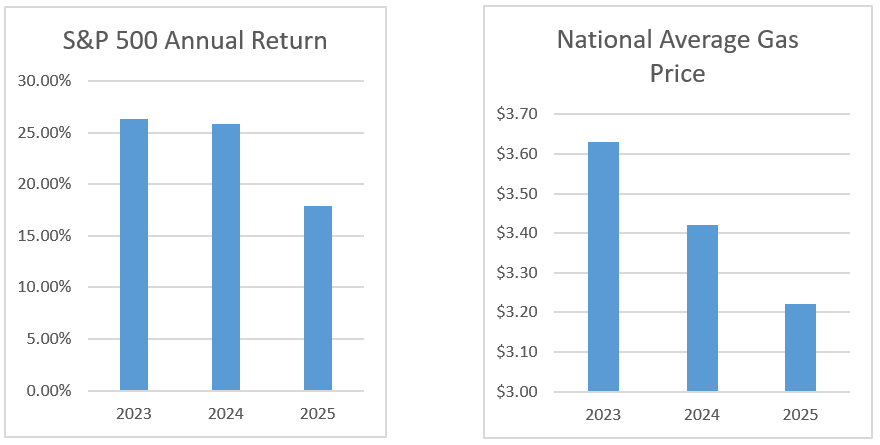
- Living in a state with some of the highest gas taxes in the country, no one would like to see less pain at the pump than I. That being said, this county has endured higher-than-average gas prices in recent years, and the market has remained resilient, posting some phenomenal returns in recent years, despite the high prices at the pump. Gas prices between 2015 and 2021 averaged $2.59 a gallon nationally, compared to the nation’s current three-year average of $3.42. Remember that oil prices can impact the market in two ways:
- Expensive gas can hurt household budgets, causing a decrease in consumer spending.
- High oil prices raise manufacturing and transportation costs, cutting profit margins and corporate earnings. Corporations combat this by increasing the price of goods, thereby increasing inflation.
It’s interesting to look at an odd correlation between decreasing national gas prices and decreasing market returns over the last three years. I only point this out to illustrate how these numbers don’t always correlate in the manner expected.
- I would like the war to end regardless of its impact on markets. I see the cost of lives as far more painful than the cost of market returns or the cost of fuel, but it’s my job to advise on the impact current events might have on my clients’ portfolios. I don’t advocate for broad market exposure such as index investing, regardless of current market conditions. I focus on a bottom-up approach to stock analysis, where I look for growth opportunities in healthy companies regardless of economic conditions or market-sector expectations. Our portfolio models are carefully built to concentrate assets in stocks that have a strong long-term outlook, regardless of disruptive events, and we always anticipate disruptive events. In our focused growth strategy, we are not sidelining cash; we are positioned to capitalize on a rally in our current holdings. Our focused growth strategy is currently displaying even more stability than the broader market.
My investment clients get first priority in the calls I take to discuss this in more detail, but do reach out if you seek professional management or guidance on your portfolio positioning, whether it’s in good times or bad – I am here to serve you.
My perspective is shaped by a combination of my own research and the research of market analysts and strategists from top financial institutions around the world, ensuring my clients benefit from multiple experienced market experts influencing portfolio construction and the advice offered at Northshore Wealth Management.
It’s a snowy day at the Northshore. Today’s picture is from my garden.
Live long and live well,
Alyse



 Northshore Wealth Management